
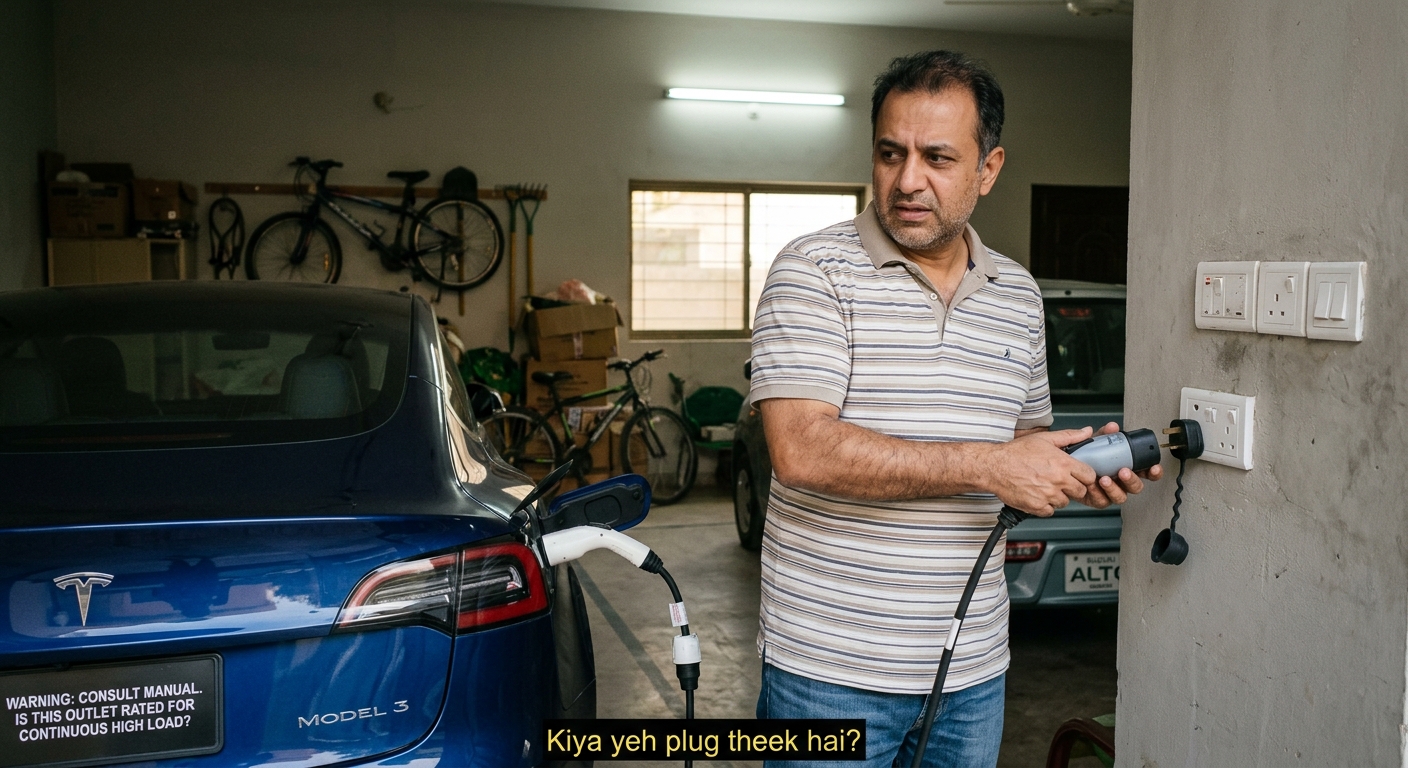
When bringing home a new electric vehicle, finding the fastest and most convenient way to recharge your battery is a top priority. While standard $120\text{-volt}$ household wall sockets (Level 1) take up to 40 hours to fully replenish an EV, existing high-voltage 240-volt outlets—such as those used for clothes dryers, electric ranges, or RV hookups—offer significantly faster charging speeds. New EV owners frequently ask: Can I just plug my EV into a 240V outlet?
The short answer is: yes, you can plug your EV into a 240V outlet, provided you use a compatible Level 2 mobile connector and the outlet is rated for continuous, high-amperage loads.
However, plugging a high-draw electric vehicle into an existing 240V receptacle requires evaluating specific National Electrical Code (NEC) safety requirements, including receptacle grade quality, circuit breaker continuous load limits, and mandatory Ground Fault Circuit Interrupter (GFCI) protection.
For complete hardware reviews, wiring charts, and installer guides, visit EV Charger Advisor.
1. How Plug-In Level 2 Charging Works
To charge your electric car from a 240V wall socket, you cannot plug the car directly into the wall with a simple extension cord. You must use a Level 2 Mobile Connector (or Portable EVSE):
The Role of the Mobile EVSE
The mobile connector serves as the safety bridge between your 240V outlet and your vehicle. It converts the outlet’s high-voltage single-phase AC electricity into a controlled stream, using internal safety relays and control pilot signal protocols (SAE J1772 or NACS) to verify ground continuity before allowing power to flow.
Common 240V Receptacle Types for EVs:
-
NEMA 14-50 (4-Prong, 50A Rating): The most common outlet for home EV charging, supplying up to 40 Amps continuous ($9.6\text{ kW}$).
-
NEMA 6-50 (3-Prong, 50A Rating): Common in home workshops for arc welders, supplying up to 40 Amps continuous ($9.6\text{ kW}$) without a neutral line.
-
NEMA 14-30 / 10-30 (4-Prong / 3-Prong, 30A Rating): Standard electric clothes dryer outlets, supplying up to 24 Amps continuous ($5.76\text{ kW}$).
To learn more about how charger power levels and plug styles compare, check out our guide on EV charging types.
2. Critical Code & Safety Considerations for 240V Outlets
While plugging in is simple, utilizing an existing 240V wall socket for EV charging introduces three vital safety factors under the National Electrical Code (NEC Article 625):
A. Residential Grade vs. Industrial Grade Outlets
Standard builder-grade $10 NEMA 14-50 outlets (designed for plugging in an electric oven once every 10 years) are not engineered to handle continuous high-amperage draw for 8+ hours every night. Plugging an EV charger into a cheap outlet often leads to blade melting and electrical fires. Installing or upgrading to an industrial-grade receptacle (such as Hubbell or Bryant) rated for heavy continuous thermal cycles is strongly recommended.
B. Mandatory GFCI Circuit Breakers (NEC 625.54)
The NEC strictly requires that all $150\text{V}$-to-ground or higher receptacles installed for EV charging in garages or outdoor spaces must be protected by a GFCI double-pole circuit breaker ($100–$180).
C. The 80% Continuous Load Limit
Under NEC rules, an EV charger is a continuous load. A plug-in charger connected to a 50A outlet must be capped at 40 Amps continuous draw ($50\text{A} \times 0.80 = 40\text{A}$).
Step-by-Step Mathematical Example: Charging Performance on a NEMA 14-50 Outlet
Let us calculate the continuous kilowatt output, charge duration, and range recovery when plugging a mobile connector into a 50-Amp NEMA 14-50 receptacle to deliver 60 kWh of energy to an EV battery.
Given Parameters:
-
Circuit Breaker / Outlet Rating: $50 \text{ Amps @ 240V}$
-
Max Continuous Amperage Draw (80% Rule): $50\text{A} \times 0.80 = \mathbf{40 \text{ Amps}}$
-
Energy Required: $60 \text{ kWh}$
-
Onboard AC-to-DC Charging Efficiency: $90\%$ ($0.90$)
Calculation 1: Continuous Power Delivery Output
Calculation 2: Usable Power Delivered to Battery Pack
Calculation 3: Total Charging Time Calculation
Calculation 4: Added Driving Range Per Hour
Assuming an average electric efficiency rating of 3.3 miles per kWh:
Result Breakdown: Plugging into a 240V / 50A outlet delivers $9.60\text{ kW}$ of power, fully restoring $60\text{ kWh}$ of battery energy in under 7 hours while adding 28 to 30 miles of range per hour.
To explore Wi-Fi-enabled smart wallboxes that support dynamic app management, read our guide on smart chargers.
Comparison Table: Plug-In 240V Outlets vs. Hardwired Level 2 Wallboxes
| Feature | Plug-In 240V Outlet (NEMA 14-50) | Hardwired Level 2 Wallbox |
| Max Continuous Draw | $40 \text{ Amps } (9.60\text{ kW})$ | 48 Amps ($11.52\text{ kW}$) |
| Circuit Breaker Size Required | 50-Amp Double-Pole Breaker | 60-Amp Double-Pole Breaker |
| Panel GFCI Requirement | Mandatory GFCI Breaker ($100 – $180) | Standard Breaker ($20 – $35) |
| Added Range per Hour | $28 – 30 \text{ miles/hr}$ | 36 – 44 miles/hr |
| Portability | High (Unplug and take mobile charger) | Permanent Fixed Unit |
| Thermal Risk | Moderate (Socket connection contacts) | Lowest (Direct copper connection) |
Summary & Key Takeaways
-
Fully Capable: You can plug your EV into a 240V outlet using a compatible Level 2 mobile charging connector.
-
Cap Output at 40 Amps: On a standard 50A NEMA 14-50 outlet, the mobile charger must be capped at 40 Amps continuous draw under the NEC 80% rule.
-
Use Heavy-Duty Outlets: Always verify that existing wall sockets are high-quality, industrial-grade receptacles to withstand multi-hour heat loads without melting.
-
Hardwiring Is Faster & Safer: Hardwiring a dedicated wallbox unlocks full $48\text{A}$ ($11.52\text{ kW}$) speeds, eliminates socket wear, and avoids the need for expensive external panel GFCI breakers.













Leave a Reply