
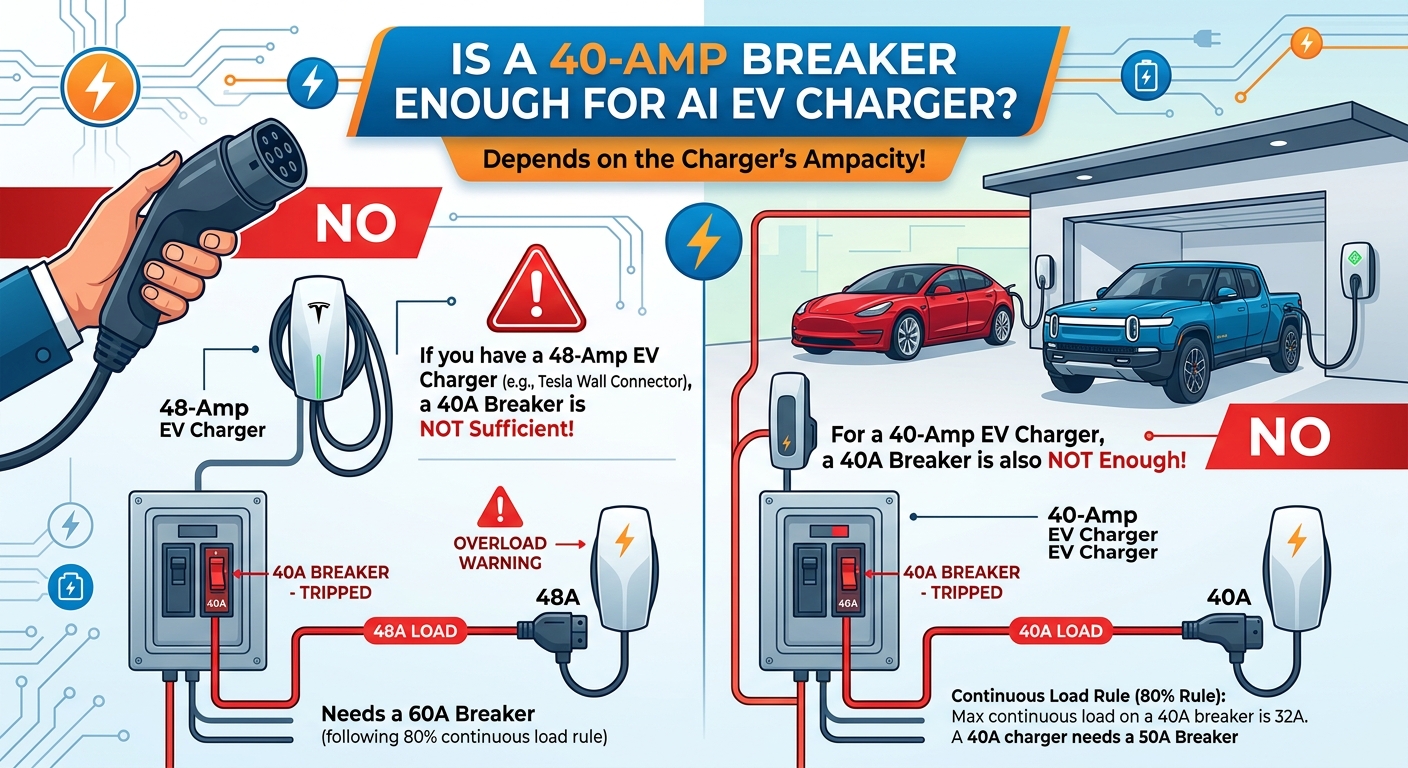
When setting up home charging infrastructure for an electric vehicle, one of the most common electrical components homeowners evaluate is a 40-amp circuit breaker. Whether you have an existing 40A circuit in your main panel or are planning a lower-cost Level 2 installation, you may wonder: Is a 40-amp breaker enough for an EV charger?
The short answer is: yes, a 40-amp circuit breaker is enough for a Level 2 EV charger, provided the charger is set to draw a maximum continuous current of 32 Amps.
Under the National Electrical Code (NEC), EV charging is categorized as a continuous load. Because of this, you cannot run a charger rated for 40 Amps continuous output on a 40-amp breaker. However, a 32-Amp continuous output charger operating on a 40-amp breaker delivers 7.68 kW of power, replenishing 20 to 30 miles of driving range per hour—making it more than sufficient for most daily home charging needs.
For comprehensive hardware reviews, panel load calculators, and installer guides, visit EV Charger Advisor.
The Core Rule: NEC 125% Continuous Load Requirement
Under NEC Article 625, an electric vehicle charger is classified as a continuous load—meaning it draws maximum rated current continuously for 3 hours or longer.
To prevent circuit breakers from overheating, thermal fatiguing, and nuisance tripping during multi-hour charging sessions, the NEC mandates that circuit breakers and branch conductors must be sized for 125% of the charger’s continuous draw (or conversely, continuous draw must be capped at 80% of the breaker’s nominal rating):
How the 40-Amp Breaker Rule Breaks Down:
-
On a 40-Amp Double-Pole Breaker: The maximum continuous current allowed is 32 Amps ($40\text{A} \times 0.80 = 32\text{A}$).
-
For a 40-Amp Continuous Charger: You require a 50-Amp double-pole breaker ($40\text{A} \times 1.25 = 50\text{A}$).
To learn more about how charger power levels and wire sizes compare, check out our guide on EV charging types.
Step-by-Step Mathematical Example: 40A Breaker Power & Range Delivery
Let us calculate the exact continuous kilowatt output, daily energy replenishment, and wire gauge requirements for a Level 2 charger installed on a 40-amp double-pole breaker.
Given Parameters:
-
Circuit Breaker Rating: $40 \text{ Amps (Double-Pole)}$
-
Max Continuous Draw (80% Rule): $32 \text{ Amps}$
-
Operating Line Voltage: $240 \text{ Volts}$
Calculation 1: Continuous Power Delivery Output
Calculation 2: Overnight Energy Replenishment (10-Hour Charge)
Accounting for standard onboard AC-to-DC conversion efficiency ($90\%$):
Calculation 3: Added Driving Range Per Hour
Assuming an average electric efficiency rating of 3.3 miles per kWh:
Calculation 4: Wire Gauge Sizing (NEC Article 310)
Conductors feeding a 40A double-pole breaker must be rated for at least 40 Amps:
-
Copper Wire Gauge: Requires #8 AWG copper wire (rated up to $40\text{A}$ at $60^\circ\text{C}$ for NM-B Romex or $50\text{A}$ at $75^\circ\text{C}$ for THHN in conduit).
Result Breakdown: Operating a 32A charger on a 40A breaker delivers 7.68 kW of continuous power, restoring over 220 miles of range during a 10-hour overnight charge using #8 AWG copper wire.
To explore Wi-Fi-enabled smart wallboxes that support adjustable amperage settings, read our guide on smart chargers.
When Is a 40-Amp Breaker the Ideal Choice?
While a 60-amp breaker ($48\text{A} / 11.5\text{ kW}$ output) offers maximum residential charging speeds, installing a 40-amp breaker is often the smarter choice in several key scenarios:
1. Limited Electrical Panel Headroom (100A / 125A Panels)
If your main panel operates on a 100-amp or 125-amp service, adding a 60A circuit might trigger an NEC Article 220 panel overload. A 40A circuit ($32\text{A}$ continuous load) requires significantly less load margin, often avoiding a $3,000 to $6,000 utility panel upgrade.
2. Vehicle Acceptance Limits
Many popular electric vehicles and plug-in hybrids (PHEVs) feature onboard AC chargers capped at 32 Amps ($7.7\text{ kW}$). For these vehicles, installing a larger 50A or 60A breaker provides zero increase in charge speed.
3. Reduced Material & Installation Costs
Wiring a 40A circuit uses #8 AWG copper wire instead of thicker #6 or #4 AWG wire, making cable pulls easier and reducing raw material costs over long garage or driveway runs.
Comparison Table: Breaker Sizes vs. Continuous Charger Output
| Circuit Breaker Size | Continuous Max Draw (80%) | Power Output @ 240V | Minimum Copper Wire Gauge | Added Range per Hour |
| 30 Amps | $24 \text{ Amps}$ | $5.76 \text{ kW}$ | #10 AWG | $16 – 20 \text{ miles/hr}$ |
| 40 Amps (32A Set) | 32 Amps | 7.68 kW | #8 AWG | 20 – 28 miles/hr |
| 50 Amps (Plug-In Max) | $40 \text{ Amps}$ | $9.60 \text{ kW}$ | #6 AWG | $28 – 34 \text{ miles/hr}$ |
| 60 Amps (Hardwired Max) | $48 \text{ Amps}$ | $11.52 \text{ kW}$ | #6 AWG THHN / #4 Romex | $36 – 44 \text{ miles/hr}$ |
Summary & Key Takeaways
-
40A Breaker Is Sufficient for 32A Charging: A 40-amp double-pole breaker supports a charger set to 32 Amps continuous draw ($7.68\text{ kW}$).
-
Never Run a 40A Charger on a 40A Breaker: A charger drawing 40 Amps continuously requires a 50-amp circuit breaker under the NEC 125% rule.
-
Restores 200+ Miles Overnight: A 32A/40A setup delivers ~23 miles of range per hour, fully recharging most EV batteries in 8 to 10 hours.
-
Saves Installation Costs: Sizing for a 40A circuit uses #8 AWG copper wire and preserves panel headroom on capacity-constrained 100A panels.













Leave a Reply